Introduction
Major industrial disasters consistently trace back to the same root cause: cultural failures, not just technical ones. The 1988 Piper Alpha disaster killed 167 workers after production pressures systematically overrode safety protocols—what Lord Cullen called a "reverse safety culture". At BP's Texas City refinery in 2005, the Baker Panel found that strong personal injury metrics masked deep process safety deficiencies, contributing to an explosion that killed 15.
Australia's 1998 Longford explosion told the same story. Professor Andrew Hopkins identified failures in both reporting culture and learning culture: employees felt discouraged from raising concerns, and warning signs went uninvestigated until two workers were dead and an entire state lost its gas supply.
This pattern holds statistically. A review of 17 major petrochemical accidents found poor safety culture contributed to 14 of them—82% of catastrophic failures. Yet most organizations respond with compliance-driven surveys that produce unreliable data and no meaningful change.
This article covers what a rigorous process safety culture assessment actually involves—the preparation required, how to implement it step by step, the mistakes that undermine results, and how to turn findings into lasting change.
Key Takeaways
- Process safety culture assessments measure shared values and behaviors that determine how safety is actually managed, not just what policies state
- Multi-method approaches—surveys, interviews, observations, and document reviews—are essential; no single method provides sufficient validation on its own
- Assessment quality hinges on leadership commitment, assessor competency, and triangulating data to capture actual behaviors—not just stated beliefs
- Build structured action plans with clear ownership and timelines, or assessments produce no lasting change
- Repeating assessments every 3–5 years provides benchmarks for tracking cultural maturity
What Is a Process Safety Culture Assessment (and Why It Matters)
A process safety culture assessment is a structured organizational evaluation that measures the combination of group values, beliefs, and behaviors influencing how safety is managed in practice. It captures what happens "when no one is watching"—the unwritten norms that guide decisions when production deadlines loom, when staffing is tight, or when safety systems conflict with operational convenience.
This differs from a safety audit. Audits verify compliance with procedures and standards—checking whether systems exist and are followed. Culture assessments evaluate whether the attitudes, norms, and behaviors exist to sustain those systems over time. You can pass an audit with perfect documentation while harboring a culture that silently erodes safety margins through normalized deviance.
The Business Case for Assessment
Organizations with weak process safety cultures face elevated incident risk, regulatory scrutiny, operational disruptions, and reputational damage. The financial consequences are significant:
- The Longford gas plant explosion cost approximately $650 million in combined losses and remediation
- BP incurred over $65 billion in total costs following Deepwater Horizon
- A Woodside offshore study found correlations between -0.53 and -0.73 between safety culture scores and process safety incident rates across six installations
- Supervisor behavior showed the strongest predictive power at -0.73—meaning culture at the frontline level is the clearest leading indicator of failures
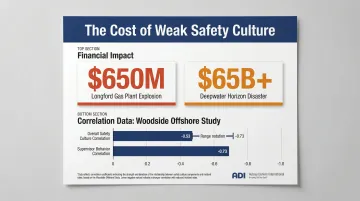
The evidence is consistent: higher culture maturity predicts fewer process safety incidents. Organizations that assess and strengthen their safety culture reduce incident exposure while building the operational resilience that supports long-term performance.
What You Need Before Conducting the Assessment
Preparation determines data quality. Assessments conducted without proper groundwork produce unreliable findings that organizations cannot confidently act upon.
Organizational Readiness Requirements
Three conditions must exist before data collection begins:
Visible leadership commitment to honest findings — Leaders must demonstrate they will use results to improve, not to punish or ignore. If employees believe the assessment is a PR exercise, they will provide socially acceptable responses rather than accurate ones.
Psychological safety — Employees must trust that candid responses won't trigger retaliation. An NRC internal study found only 68% of nuclear industry employees felt they could raise concerns without fear; 20% had heard of someone experiencing negative consequences for raising differing views. When this trust doesn't exist, assessment data is systematically biased.
Clear ownership — Someone must own the assessment process and resulting action plans. Without accountability, findings become reports that gather dust rather than catalysts for change.
Assessment Team and Framework Selection
Who conducts the assessment shapes both what employees will share and how accurately results can be interpreted:
- External teams provide neutrality and objectivity, especially in low-trust environments where employees doubt internal confidentiality
- Internal teams bring operational knowledge and context that aids interpretation
- Hybrid approaches combine both strengths—external parties ensure methodological rigor and independence while internal members provide industry-specific insight
Regardless of the model chosen, the assessment team must bring:
- Knowledge of safety culture frameworks and organizational psychology
- Group facilitation skills and qualitative data interpretation
- Familiarity with the specific operational hazards your organization faces
ADI's behavior-based approach, grounded in over 45 years of applied behavioral science, offers a structured methodology for distinguishing what behaviors leaders believe are being reinforced from what is actually happening on the floor.
How to Implement a Process Safety Culture Assessment
Step 1: Define the Scope, Framework, and Objectives
Clarify which dimensions of safety culture you will evaluate. Common dimensions include:
- Leadership commitment and accountability
- Employee empowerment to stop unsafe work
- Reporting environment and psychological safety
- Organizational learning from incidents and near-misses
- Normalization of deviance and production pressure
Select a framework that fits your context. Three widely used models include:
- CCPS Risk Based Process Safety (RBPS) — organizes process safety into four pillars with culture as the first element of "Commit to Process Safety"
- IAEA framework — structures assessment around five characteristics: safety as a recognized value, clear leadership, defined accountability, integration into all activities, and learning-driven improvement
- CER framework — uniquely organizes eight dimensions into cultural threats (production pressure, complacency, normalization, tolerance of inadequate systems) and cultural defenses (committed leadership, vigilance, empowerment, resiliency)
Choose or adapt one that aligns with your industry and can be consistently applied across future cycles.
Step 2: Select Your Data Collection Methods
A multi-method approach is mandatory. The U.S. DOE found 5 of 8 assessed organizations could not demonstrate their surveys had proven validity, meaning their conclusions rested on uncertain foundations. Organizations relying solely on surveys cannot validate or credibly interpret results.
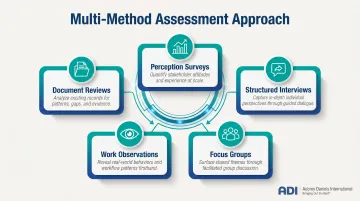
Use at minimum three distinct methods:
Perception surveys — provide quantitative breadth and benchmarking across organizational units. IAEA guidance recommends minimum response rates and independent administration to avoid bias.
Structured interviews — enable in-depth exploration of emerging themes, probing the "why" behind survey patterns.
Focus groups — capture interactive, group-level insights that reveal shared norms and unspoken expectations.
Work observations — compare espoused values against actual behaviors in the field, identifying gaps between what people say and what they do.
Document reviews — analyze policies, incident reports, and audit records to identify gaps between stated commitments and operational reality.
Survey design must meet basic validity standards: questions pre-tested, response rates meeting established guidelines, and confidentiality assured through independent administration to prevent response bias.
Step 3: Collect Data Across All Levels of the Organization
Data collection must span all organizational levels — from the boardroom to the production floor — because safety culture attributes often vary significantly between senior leadership, middle management, and frontline workers. These gaps are themselves critical cultural signals.
Interviewing and focus group best practices:
- Use semi-structured question sets that allow flexibility while ensuring consistency
- Train facilitators to manage power dynamics and confirmation bias
- Prioritize psychological safety so participants share candid perspectives, not socially acceptable answers
- Ask participants to describe specific recent examples, not just general impressions
Behavioral observation is essential. Observing actual work behaviors reveals whether safe practices are consistently reinforced or whether production pressure and normalization of deviance are occurring in practice. Structured behavioral observation methodology identifies what is actually being reinforced on the floor versus what leaders believe is happening — closing the gap between intention and reality. ADI's behavior-based approach applies this discipline with precision, giving organizations credible evidence rather than leadership assumptions.
Step 4: Analyze and Triangulate the Data
The assessment team should:
- Extract recurring themes across all methods
- Look for convergence where multiple sources point to the same strength or weakness
- Identify divergence where findings conflict, signaling need for deeper investigation
- Highlight disparities between espoused values and observed behaviors
Segment findings by organizational level, functional area, and shift or site where relevant. Patterns in subgroups often reveal where specific cultural risks concentrate rather than being organization-wide.
Step 5: Report Findings and Communicate Results
With analysis complete, findings need to be packaged in a way that drives action, not just awareness. Structure the assessment report to include:
- Executive summary with headline findings
- Maturity rating against the chosen framework
- Key strengths to preserve
- Priority weakness areas requiring intervention
- Supporting evidence for each finding
Communicate results effectively across levels:
- Leadership: present prioritized action areas with resource implications, not a full data dump
- Frontline employees: share plain-language summaries that close the loop — their input shaped the findings, and they should know it
Failure to communicate findings back to participants damages trust and signals that leadership doesn't value their perspective — a cultural signal that undermines future engagement.
Key Variables That Affect the Quality of Your Assessment
Sound methodology alone doesn't guarantee a credible assessment. Four variables, if left unmanaged, will corrupt your data before you ever analyze it.
Survey Validity and Reliability
The DOE found most assessed organizations couldn't demonstrate their surveys had proven validity (do they measure what they claim?) or reliability (would participants answer consistently over time?). Poor survey design produces data that looks credible but can't support sound decisions.
The practical consequence: organizations confidently prioritize interventions based on flawed data, targeting the wrong cultural dimensions entirely.
Leadership Behavior Alignment
Culture is modeled from the top. When leaders behave differently from stated safety values — pressuring production over safety in conversations observed during data collection — the assessment surfaces an inconsistency that undermines everything else.
When leadership isn't genuinely committed to honest findings, results get sanitized. Participation becomes guarded, sensitive issues go underreported, and action plans lack teeth.
Psychological Safety of Participants
If employees don't believe their responses are truly anonymous — or fear retaliation for raising safety concerns — they provide socially acceptable answers rather than accurate ones. The NRC study found approximately one-third of nuclear industry employees lacked confidence they could raise concerns safely.
Low psychological safety doesn't just skew survey results. It biases every data collection method, producing a false picture of cultural health that masks real vulnerabilities.
Behavior vs. Perception Gap
Significant gaps often exist between what employees and leaders believe is happening and what actually occurs in the field. Measuring only perceptions misses this gap entirely.
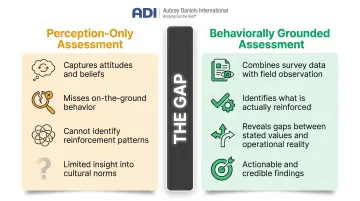
Assessments that rely solely on self-reported data can't identify the reinforcement patterns — which behaviors get rewarded or punished — that actually drive cultural norms. Closing this gap is what separates compliance-based assessments from those grounded in behavioral science:
- Perception-only assessments capture attitudes and beliefs but miss on-the-ground behavior
- Behaviorally grounded assessments combine survey data with field observation to identify what's actually being reinforced
- The gap between the two often reveals where stated safety values diverge from operational reality
Common Mistakes When Conducting a Process Safety Culture Assessment
Even well-intentioned assessments can produce misleading results when common design flaws go unaddressed. The four mistakes below account for the majority of failed or inconclusive safety culture assessments.
Relying on surveys alone — Single-method approaches appear rigorous but produce results that can't be validated, triangulated, or acted on with confidence. Surveys measure what people say; observation and interviews reveal what they actually do.
Excluding frontline workers — Assessments that over-index on leadership perspectives miss where production pressure, normalized deviance, and reporting hesitancy are most visible. Frontline workers hold critical signal — they're rarely the loudest voices in a survey sample.
Failing to establish credible confidentiality — Internally administered surveys reduce assurance of anonymity and suppress honest responses. Conducting the assessment through an independent third party significantly improves response rates and data reliability.
Treating the assessment as a one-time event — A single assessment produces a snapshot, not a sustainable improvement program. Without repeating cycles, organizations lose the ability to track progress, benchmark improvements, or catch cultural deterioration before it contributes to an incident.
What to Do After the Assessment: Translating Findings into Action
The assessment itself creates no safety improvement. Value is only realized through a structured action plan that prioritizes interventions, assigns clear ownership, sets measurable targets, and defines timelines.
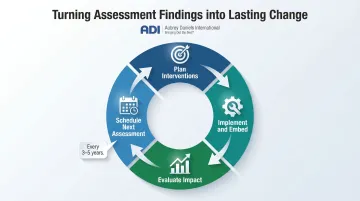
The post-assessment cycle:
- Plan interventions based on prioritized findings
- Implement and allow sufficient embedding time
- Evaluate impact using defined metrics
- Schedule next assessment cycle
How to prioritize interventions:
- Address critical weaknesses affecting psychological safety and leadership behavior before superficial ones
- Differentiate between interventions needed at board/executive, middle management, and frontline levels — each tier requires a different approach
- Focus on behaviors that data shows are not being reinforced despite stated importance
Follow-through is itself a cultural signal. When employees see findings translate into visible changes, trust in the process and in leadership grows — and engagement in future cycles follows. Organizations should plan follow-up assessments every 3–5 years to measure impact and maintain accountability.
Frequently Asked Questions
What is a safety culture assessment?
A safety culture assessment is a structured organizational evaluation measuring the shared values, beliefs, and behaviors that influence how safety is managed in practice. It differs from compliance audits by focusing on culture—the unwritten norms and actual behaviors—rather than documented systems.
What are the 4 pillars of process safety management (PSM)?
CCPS's Risk Based Process Safety (RBPS) model organizes PSM into four pillars: Commit to Process Safety, Understand Hazards and Risk, Manage Risk, and Learn from Experience. Safety culture falls within the "Commit to Process Safety" pillar as the foundational first element.
How often should a process safety culture assessment be conducted?
IAEA and CER guidance recommends a full assessment cycle every 3–5 years. This interval gives implemented interventions enough time to embed before the next evaluation.
What is the difference between safety culture and safety climate?
Safety climate refers to employees' current perceptions of how safety is prioritized—a snapshot in time typically measured by surveys. Safety culture reflects deeper, more stable values, norms, and behaviors that shape how safety is managed over the long term.
Who should conduct a process safety culture assessment — internal or external?
A hybrid approach is generally most effective. External parties provide neutrality and methodological expertise, especially in lower-trust environments, while internal members contribute operational knowledge and contextual understanding that sharpens how findings are applied.
What happens if the assessment reveals serious cultural weaknesses?
Treat serious findings as high-priority risk, not a reputational concern. Disclose them honestly to leadership, build a prioritized intervention plan, and bring in external support if behavioral or systemic drivers run deep.